Sunday, November 13, 2011

Another Kölsch experience

Well, I am definitely not a picky guest and always open for new stuff. Being invited for a friend's birthday party, there was an option of having wine or beer from Cologne. As the reader might imagine, Michael and Kölsch doesn't fit together.
But I gave it a try, because it was an organic one from a micro brewery in Cologne I did not know.


Heller is a small brasserie in the south of Cologne. Without any serious prejudices, I had two bottles and was positively surprised: unlike the thin taste of regular Kölsch, this one has a decent character, spicy and a little hoppy. Due to the fact, I had to be the family chauffeur, I switched over to water later the evening. Otherwise I would have stayed with the beer much longer.
But what always happened with Michael and Kölsch, also happened with Hellers the next morning: waking up, I felt like having drunken 10 bottles of the stuff, not just two. This curiosity happens anytime I give Kölsch a try. I won't complain, pointing out the "bad" quality of brewing tradition in Cologne. My explanation: being from Düsseldorf, my body just developed special defence shields for a beer from Kölle ;-)

Saturday, November 5, 2011

A surprise

Innocently, I drove to my favourite beer store today for getting some bottles for tonites board game evening with friends.
I was happy to find some new brews of my most liked German brasseries (Meister and Unertl; tasting notes later), but the most astonoshing thing happened, when I went towards the cashier. It was a beer bottle, designed like the Belgian ones. And the label said that it is an IPA, brewed in Germany, Bonn. What happened? My favorite beer, brewed by a brasserie in my small home town???? I gabbed of course on bottle and asked the boss, whether he might give me some background notes.

That's what he told me: Fritz is a Bonn-based expert on Belgian beer and he is close with a well-known Belgian beer sommelier. After tasting so many beers, both decided to brew some favorite beers themselves. The first one was an IPA, followed by a Stout. He rents some space in a brewery in Cologne and in the monastery in Siegburg for brewing and storing in barrels. This sounds more than interesting!! I did not taste the IPA so far, but will do it very soon. My tasting notes will follow soon.

This is, for the beginning, the website of the Belgian-Bonn brewery: www.fritzale.de

Monday, August 29, 2011

Düsseldorf's brewing innovations

Picking up ou new US student at Düsseldorf airport, I found some time (his flight was 4 hours late) to drive to my favourite beer grocery in Ddorf for buying some new Schlüssel Alt, which is my favourite summer Alt, because of its light jasmine flavour.

But hey, this shop has more to give away than the nice fluid of Ddorf's Alt.

At first, I found a rare bottle, I was desparately searching for a whole year now: Uerige, my other favourite, decided last year to brew a lemonade, using malt, hops and elder flower. Not only my minor daughter was more than happy about our discovery.


It is not sweet at all, has a slight taste of caramel with a decent note of the natural elder flower that is used to brew the lemonade. A little bit, it reminds me of the German malt beer, but not as sweet as it. So it's a refreshing summer lemonade, but brewed and it has a nise foam as well :-)

The other discovery was a new brew by Füchschen, which is in fact my third favourite micro brewery in my hometown. They decided to "go to Bavaria", by brewering a Hefeweizen (yeast wheat beer) and guess what: it's delicious!!!

Most of the original Bavarian Weissbier is too sweet, or too boring for me. But this one is different. It can not hide its family background from Ddorf with the bitter, hoppy note. It definitely has its unique character, which most of the Bavarian beers don't have :-) Even my friend Peter, who I could never convince to become a fan of Alt beer, loved the Silber Füchschen.


—-- Written on iPad

De Garre

Even without any summer vacation this year, the family decided to do a day trip to Bruges and the coast at De Haan. Finally, our Stroehlein friends invited us for dinner in Bruxelles, so we had a very convenient and delicious stop on our way back home.

Before going to Flandres, I already informed myself about possible micro-breweries in the city and found one on a blog. The authors mentioned that it has even no address and would be difficult to locate because it is located not in a street or a lane, more in a backyard between two houses near the main place of Bruges.

I don't know, but without any direction I found the "lane". Looked like being transfered from one of the Harry Potter stories.


For any of you, who wanna go there, I will try to give you a hint where you might find it. It's called De Garre and beside brewing beer, they have a very small pub, too (the entrance is the one with the steps). Inside, you feel like in reformation times, the ground floor has probably six tables, the first floor not more :-)


They have about 100 different Belgian beers in bottle, and the home-brewed De Garre on tap. Obviously, we tried this one and, for the record, during one visit you are not allowed to order more than 2 glasses of it. We didn't try it, but being there at lunch time without any food in our stomach, two glasses were enough :-)


And you should really try it, it is delicious. It's a triple beer, with probably 11% alcohol, sweet at the start, then fruity with some melon tastes, the finish is a decent bitter note. It was really fun to look for that place and try its beer.

After leaving the place, it was difficult following the girls on their shopping safari, but finally I found a good place:


Friday, July 22, 2011

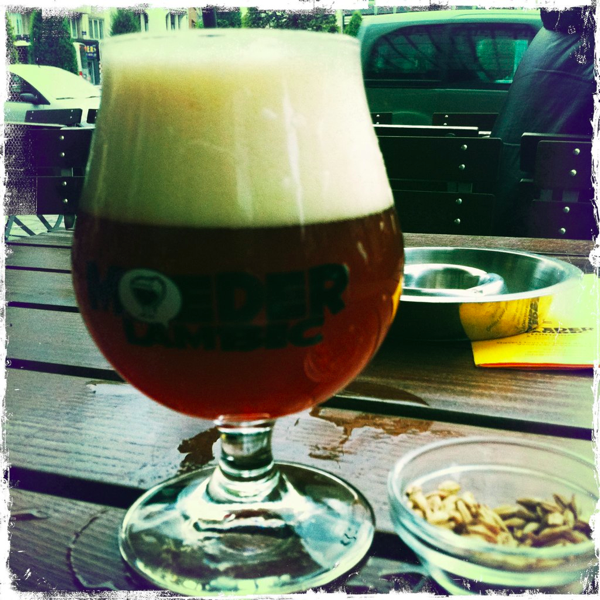
New July draughts @ Moeder Lambic

After my return to Brussels, and before going to bed at my hotel near the Midi station, it was time again to visit Moeder Lambic at Place Fontainas and try some of the guest draughts.

My first was a new one from Brasserie Rulles, the Meilleurs Voeux:

NewImage

Compared to other beers from Rulles, I was quite disappointed. It is slightly sour, with a finish of different herbs. But all together, it is not well balanced and to some extend flat and boring.

As I knew, that the Moeder Lambic team would not let me leave without a positive surprise, I ordered a Plat Mixte with the georgious Belgian cheese and sausages, to neutralize the Rulles flavour a bit, and tried the next one.

I chose an IPA from Viven, a brasserie I did not know before. The beer is called "Viven Imperial IPA" and guess what: it was a blast. I probably don't remember having a better IPA than this one.

NewImage

Viven is a small brasserie, founded in the late 90's, located in Sisjele, a small Flemish village. The first taste was a very fruity one, a mix between melon and peach; for an IPA surprising enough. After the fruity start, the IPA-like bitterness reaches mouth and nose, combined with a very hoppy note. All those tastes together results in a tremendous good beer, definitely on of my top ten. For my next visits in Belgium, I will try to find some more beers from this smal brewery.

As a dessert, one should not order chocolate, cake or someting else at Moeder, but a beer again. So I did :-) I was happy to read on the board, that they have a Trappiste beer on draught, a St. Bernardus 12. As it is quite difficult to find Bernardus beer outside of the region, where it is brewed, I had to give it a try. And I was lucky: Having a dessert to eat, one won't find so many different tastes and smells like having this one.

NewImage

The first feeling you have when drinking it is like biting into a bar of very good marzipan. After the almond taste leaves your tasting nerves, roasted malt start to blow, together with a very decent note of hop. Though I have to admit, that this one might not be a beer for the summer, I made the right choice, especially because the temperature that evening wasn't too high.

Tuesday, July 19, 2011

The St. Pancras International Heaven

Yes, I know: it took months until a new post here. I will promise to be a bit more stable in writing!

Although Andrew the Beer Pope told me already about the good variety of English beers in a shop at St. Pancras, I never found the time to look out for it. Yesterday, I took the chance to walk around, because I had still an hour to go for my Eurostar (uncomfortable as ever, by the way) and at Tesco, I did not find any new stuff.

And there it was: Sourced Market, a deli place, located at Kings Cross, not at International. And I found a good variety of English Ales and Lager I did not know before. Additionally, I bought a bottle of an American IPA.


You dear reader will be informed about my tasting notes later :-)

With a very heavy bag, I returned to Bruxelles, where I spent the night. And yes, I made a stop at Moeder Lambic, because they have some good new "guest beers" announced and I wanted to give them a try. Those notes will follow soon.


Friday, February 4, 2011

Probably the most bitter beer I had so far

As many of my readers might know, I love deep flavoured beers, especially the bitter ones.
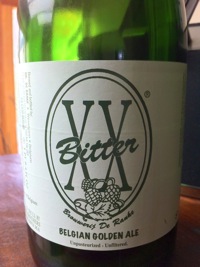
Therefore, I was more than happy to have found a Belgian beer, called XX Bitter. Unfortunately, that was already the last bottle from my recent trip to Brussels, so I am happy to return next week for some political meetings, adding some shopping of course.
Photo Feb 04 11 11 20
XX Bitter really surprised me, positively of course. It comes from a small micro brewery in Welvegem, called De Ranke. The colour is bright golden, with a close dazzling yellow nuance. In addition, it is not clear but milky, because the beer is an unfiltered one. The bottom of the bottle is opaque with yeast.
The first smell is not a bitter one, but filled with citrus and sweetness. That's also the basis for the first taste, together with some spicy undertones. At that moment I was wondering, why De Ranke called this stuff XX Bitter. But then it happened: After the beer left the tongue and went down slowly, it smashed me with a really hard bang of bitterness. Then I was convinced that it is extra bitter.
The alcohol is not too strong with 6.2%, but more than enough for an Indian Pale Ale (IPA). So in total a very good beer.

Saturday, January 29, 2011

Equinox - a very remarkable beer

After I received some disappointed feedbacks from some folks regarding my post on Deus, I had to do a better job next time. This of course would depend on the beer as well.
There were still two bottles in the fridge, one of them Equinox from the Brasserie de la Senne near Brussels. The logo interested me and the design was good enough for chosing this one for a Friday evening, while watching the newest "Silent Witness" episode.
IMG_1345.jpg
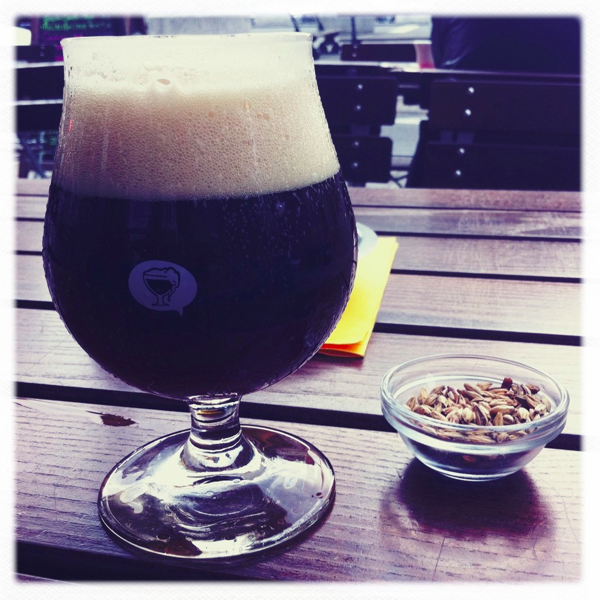
And the decision was more than the right one: This is a marvellous drop. While pouting it into my new Moeder Lambic glass, a dark black fluid comes out of the bottle, like a stout.
The bouquet remebered me of some herbal honey, mostly thyme honey. When it is in your mouth, a mix of roasted cocoa with a fresh melted caramel flavour welcomes you and while going down, a distinct taste of yeast and hops is saying farewell.
With 8%, the alcohol is typical for a Belgian beer. I definitely have to visit the brewery one day, because I am quite sure, the other beers from that place are also fantastic.

Wednesday, January 26, 2011

Deus Brut des Flandres

Yes, I of course brought some beer bottles from my last stay in Brussels back home, but this one was already waiting for me in the cellar.

It is a Deus, the bottle looks more like a Champagne one, obviously you have to use champagne flutes, not an "ordinary" beer glass :-)


The brewing method is still quite young, probably an invention from last century, when someone wanted to combine Belgian brewing art with French Champagne savoir vivre.

The sparkling beer requires a production time of many months. Made of barley, it is brewed in Belgium and refined in France using an ancestal technique, including the "riddling" and yeast removal. In total, there are three fermentation processes.

It is indeed, having tasted it, a unique mix between Champagne and beer with a very fuzzy note, which I normally don't like when drinking. The smell and the taste in the mouth ist quite the same: an interesting mix of yeast and dry oranges. When it goes down, the yeasty taste disappears and the sunny oranges remain long in your mouth and nose.

In total, very interesting indeed, but I would say that the sparkling note, which is probably one of the other main characters of this beer, is not my style.

Tuesday, January 25, 2011

My Moeder Experience

After a quite successful event in front of the European Commission building, to welcome Mr. K in Brussels (so he didn't have the feeling that only Barroso and Rasmussen were happy to have him in town), it was time to celebrate this in a more private atmosphere.
As one of my colleagues, I mean the US/UK guy in Brussels, who is the probably best expert on Belgian beers in Europe (you have to check out his blog), knows that I am also quite a big fan of beers, he decided to take us to the best beer place in Brussels: The Moeder Lambic Fontainas. As I tweeted yesterday already, this is my new favourite place in town: 46 beers on draught, unbelievable!!!!!!!
Moeder.png
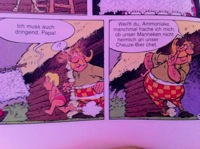
Though I already tried some Belgian beers before (as you might imagine), it was my first event that really got deeper into the "mysteries" of Belgian beer. As a German and a fan of English Ale/Irish Stout, I was quite curious and at the same time still sceptical regarding the famous brews of our neighbours: A non-Belgian always complains about the uniqueness of the German "Reinheitsgebot", compares Belgian beers with Inbev and, finally, remembers the Asterix story, where you always have to run to the toilet after some glasses of beer.
From Mike.jpeg


So, guess what: .... I was thrilled by the stuff tasted :-)
Zeezuiper.png
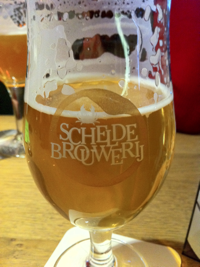
It started with a Zeezuiper from the small micro brewery Scheldebrouwerij in Meer, near Antwerpen.
This was an amazing beer, aromatic, with the taste of fruits, combined with a distinct yeast finish. Though not a light one with 8%, you did not taste the alcohol at all. The finish then is slightly different, because it is a bitter one, but not intense.
The next remarkable one is a classical Brussels beer, the so-called Lambic.
Lambic.png
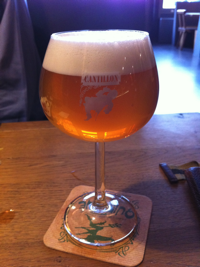
I tried a Lambic Cantillon. Not so much alcohol as the classical Belgian beers (5%), the waitress warned me when I ordered it: "Did you have it before already? It might taste very strange to someone, who never tried it!" This announcement was even more a challenge :-) The taste is really unusual, having in mind the "normal" taste of beer: very sour and dry, close to a fresh squeeze of lemon. Let me give the explanation why: Unlike conventional ales and lagers, which are fermented by carefully cultivated strains of brewer's yeasts, lambic beer is instead produced by spontaneous fermentation: it is exposed to the wild yeasts and bacteria that are said to be native to the Senne valley, in which Brussels lies. It is this unusual process which gives the beer its distinctive flavour. The first two sips were unusual, then simply great.
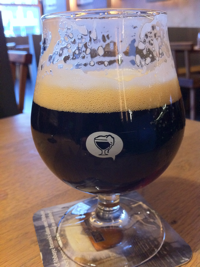
The last remarkable one (I had others, too, of course) was another one from Schelderbrouwerij, the so-called Oesterstout.
Stout.png
Yes, another "Wow". As a big fan of the Isle's stouts, I was very curious what the Belgians could create with this dark beer: of course a lot of more alcohol (instead of 4,2% 8,5%) a marvelous mix between sweetness and bitterness. It reminded me of a dark chocolate, combined with a (sea)-salty finish, probably great with seafood like oysters or mussels.
I did not only drink, but also had a snack: Moeder has a delicious variety of cheese and sausages, perfect partner for the wonderful beers :-)

Wednesday, January 19, 2011

Delirium tremens

After a disappointing working day - I was expecting an official statement by Barroso that he would refuse to have tea with the Uzbek President Karimov next Monday -, the impossibility to join a strategy meeting, combined with beer tasting in Brussels and the horrible defeat of the Germans today during the handball world championship, I decided to lay down on the couch, together with a nice bottle of Delirium Tremens.


Although tasted it already two weeks ago in Brussels, today's the time to concentrate on the stuff.

The label is famous (the pink elephant), the pub near Grand Place in Brussels is famous, and the beer itself?

With 8.5% alcohol, triple fermented, the first smell and taste is fruity, not as intense as other Belgian beers. After that, the yeast comes into the game, remembering me of some Bavarian Weissbier. Unfortunately, that's it!!! Still I was waiting for some other flavours, that first were not present, but even after half the glass, nothing else happened.

Don't know yet, if the tap Delirium is different, but this one definitely was the final conclusio of the day: Disappointing.


Tuesday, January 18, 2011

Leffe Brune

After dealing with upcoming Karimov's visit to Brussels January 24, I decided to have the first of Alain's Belgian beers, he brought to Bonn together with his son.


Just by chance, I thought that Leffe would be a good start (Deus will have to wait for a special occasion, Chimay Grand Reserve has to rest for a long time to develop), I opened it up yesterday evening.

After finishing the bottle with our guest student from L.A., I was somehow disappointed: comparing to other Belgian beers, it is quite flat. Though I am a big fan of malty beers, this one is one the one hand too sweet, otherwise the taste is mo or less unbalanced and I didn't get any characteristic flavour out of it.

I can imagine that the blonde version is even more disappointing.

So I am looking forward to Deus and Delirium Tremens :-)


—-- Written on iPad

Saturday, January 15, 2011

Meister Festbier

Ok, I shift now my beer tests to the blog, especially to give some more insight, though I don't try to compete with Andrew's
Beer blog, focusing mainly on the huge Belgian variety of beers.

My today's choice, again bought at probably one of the finest beer groceries in the Rhineland, was a Festbier by the small brewery Meister from Unterzaunsbach in Bavaria.


Though the label looks like it would be a drink for CSD, I assume that the Bavarian guys from the Oberpfalz, who are more or less "conservative", didn't guess possible consequences when labeling in pink.

The Festbier, brewed in autumn for special occasions, is one of the best I've tried. It is a dark one, with a discrete sweetness and overlaid by spicy fruitness. Other Festbiers have sometimes a quite intense caramel flavour, this one definitely not. In addition, it is not carbonated too much, so I did not miss the fizzyness. The water for the brew comes from a brewery-owned fountain.

So, in total, a very remarkable Festbier.


—-- Written on iPad


Position:Röttgener Straße,Bonn,Deutschland

Tuesday, November 9, 2010

Statement on energy, security and democratic development in Turkmenistan

As a representative of Eurasian Transition Group, I was asked to give a statement on human rights, democratic development and energy security for a conference, organized by the German Government together with FRIDE. If you are interested, you might find the text here


—-- Written on iPad

Thursday, November 4, 2010

Aliyev's Recent Blog Post - Rhetorics of a Hauted?

Although I am tired of playing a return ball to Dr. Aliyev’s ongoing „op-ed“ war against my person and Eurasian Transition Group, I would like to give a brief comment on his recent blog post. At the same time, let me underline the fact that I am not willing to participate further in a publishing battle with accusations and responds of a fugitive, whose personal reputation is at least doubtable.

Dr. Aliyev published a blog post yesterday, in which he mixes several, in my view unconnected pieces to one so-called article. He is saying that „the German spin doctor Michael Laubsch is guilty of defamation and was sentenced to pay a huge fine by a court in Vienna.“ Speaking in kind words, this is a more or less naive interpretation of the facts.

After Dr. Aliyev and his PR-company Brandstätter Business Communications published a press release, saying that I am in friendly and permanent contact with the Kazakh Security Service KNB, I decided to use judicial ways for revoking this lie. Although my lawyer issued a revocation application not only for the agency, but also for Dr. Aliyev, the Vienna court was not able to deliver the petition to Aliyev’s Austrian postal address, his lawyers refused to receive it, saying that he would be no longer living in Austria. Therefore, we only could take legal actions against Brandstätter Business Communications.

In the decision of the court, the judge said that all claims made by us were rightful and that Brandtstätter has to revoke its statement against my person. Right after this judgement, the PR-agency used its legal right to an appeal to a court of first instance. The decision of the judge here was in favour of Brandstätter, saying that it is not a bad reputation having contact with foreign secret services and that our sources we used for our investigations could be ones based in the KNB.

No word about guilt, penalty, etc., because we did not take legal actions in the criminal law and we were the party that made a court appeal. Therefore, we were only asked to cover the lawyer’s costs of Brandstätter’s side, which is common practice in all Western judiciaries.

It also has to be noted that we did not accept the second judgement and will make an appeal to a court of second instance, which then will be the final stage for both sides to have a legal decision.

Maybe Brandstätter Business Communications did not inform its client Dr. Aliyev correctly about the current status of the judicial proceedings in this case, or Dr. Aliyev as a medic is not familiar with judicial terms, otherwise the blog entry does not make any sense, especially when Dr. Aliyev is adding stories about legal investigations against him in Berlin, that have no connection to our case and ETG’s former and present dialogue with all civil and political groups in Kazakhstan, an essential part of our work.

Friday, October 9, 2009

Obama and the Nobel Peace Prize

By NICHOLAS KRISTOF
So what do you think of President Obama winning the Nobel Peace Prize? I?m nonplussed ? I admire his efforts toward Middle East peace, but the prize still seems very premature. What has he done?

Obama?s work on the Middle East, mostly through Senator Mitchell?s efforts, are sensible but haven?t produced any results yet. They certainly don?t match the intensive efforts that Bill Clinton made with his Middle East peace negotiations in the fall of 2000. Likewise, Obama?s efforts on nuclear non-proliferation are important, but they are purely an aspiration. All the hard work is yet to come ? and trying to renegotiate the NPT will be very hard indeed.

In other areas, Obama has done little. He?s been largely absent on Sudan, Congo, Burma and global poverty and health issues, and doesn?t even have a USAID administrator. I think he has the right instincts on these issues and expect him to get engaged, but shouldn?t the Nobel Peace Prize have a higher bar than high expectations? Especially when there are so many people who have worked for years and years on the front lines, often in dangerous situations, to make a difference to the most voiceless people of the world? I think of Dr. Denis Mukwege at the Panzi Hospital in eastern Congo, or Jo and Lyn Lusi at the Heal Africa Hospital also in eastern Congo, or Greg Mortenson traipsing all over Pakistan and Afghanistan to build schools, or Dr. Catherine Hamlin working for half a century to fight obstetric fistula and maternal mortality in Ethiopia, or so many others. In the light of that competition, it seems to me that it might have made sense to wait and give Obama the Nobel Peace Prize in his eighth year in office, after he has actually made peace somewhere.

In any case, I do hope that the Prize gives Obama a bit more political capital in his Middle East peace efforts, and a bit more confidence and willingness to bang heads there when necessary.

Wednesday, October 7, 2009

What Does Russia Think?

If we want to deal with Russia, we need to understand it. But since the end of the Cold War the dominant discourse in the West has focused on what Russia lacks -- be it Western-style democracy, the rule of law, or property rights.

These may indeed be missing, but Russia has ways of justifying their absence or claiming that they are present in uniquely Russian forms. This may be just a cover story, but we need to look at the Russian debate to find out.

One thing is clear. Since the end of a period in the 1990s when anything that smacked of ideology was anathema, Vladimir Putin's Russia has been quietly rediscovering the power of ideas. Today's Russia has a lively intellectual debate that cites thinkers as diverse as Slavoj ?i?ek and Carl Schmitt, and also produces a range of domestic ideas on national identity, the Russian political system, modernization, globalization, and international politics.

"What Does Russia Think?" is a collection of essays by leading Russian political observers that was released this month by the European Council on Foreign Relations. The papers are the product of a conference of the same name held in Moscow on the eve of U.S. President Barack Obama's visit to Russia in July, and they form a useful guide to the intellectual discussion currently going on in Russia.

In the Western media, the Russia debate is normally presented as a straightforward face-off between the regime's apologists and its liberal critics. But this masks a far more complex reality. The common ground shared by Putin's generation is neither liberal proselytism nor nostalgia for Stalinism, but the cumulative experience of the "20-year crisis" since the late perestroika era and the existential crisis produced by the unexpected independence of the Russian Federation in 1991.

Their worldview is shaped by what they see as a double failure - of both Soviet authoritarianism and of Boris Yeltsin's anarchic version of democracy.

The Putin Consensus

Vyacheslav Glazychev, a publisher and a member of Russia's Public Chamber, claims in his essay for the volume that "a fear of empty space" is the main underlying reason for supporting Putin. Free Russia NGO Union head Modest Kolerov identifies the secret of Putin's success in the fact that he is the first Russian leader to embody both a security and a social consensus -- restoring the power of the state after its near collapse in the 1990s and supposedly reigning in the oligarchs.

Both authors claim it is wrong to think of this consensus as a temporary aberration, soon to be replaced by a resurgent liberal elite. The "Putin consensus" is not just a transactional relationship based on high oil prices.

While Yeltsin's Russia was inclined to imitate Western models, the Russia of Putin and Dmitry Medvedev is trying to come up with a model of its own. As the essay by political scientist Leonid Polyakov shows, the overarching quest for most Russians is not to join the West, but to free themselves from the West. And in the long term, "the task before us is to turn Russia from an imitator of other civilizations into a model to be imitated by others."

Nevertheless, for the moment at least, the "Putin consensus" is still largely a negative phenomenon. The regime's intellectual supporters can agree on what they do not want, but they do not agree on what the Russian economy or society should look like in 10 or 20 years' time.

Center for Post-Industrial Studies director Vladislav Inozemtsev argues that "there is no consensus in favor of modernization. In most countries that have successfully modernized in recent years, there was a widespread feeling that the country was trailing not only the great powers but even its regional partners. However, the political elite claims that Russia is already successful, while a large part of the entrepreneurial class and the ruling bureaucracy derives its riches from oil and gas extraction and other resource-producing companies, and is therefore not interested in modernizing industry."

Inozemtsev continues: "There is little understanding of what modernization actually requires. Modernization is often confused with the development of a high-tech knowledge economy rather than improvements in manufacturing industry."

In the early stages of the global economic crisis, therefore, many in the West predicted that as the oil price collapsed, Russia's modernizing economists, such as Finance Minister Aleksei Kudrin, would seek to patch things up with the West. "Ekspert" editor Valery Fadeev argues that the crisis has in fact strengthened the statist elements of the Putin consensus, leading the Kremlin to consolidate its grip on the economy and to clip the wings of various oligarchs. Moreover, the fatalism of Inozemtsev's piece shows how beleaguered economic reformers have become now that the price of oil has returned to over $70 a barrel.

Multipolar Or Unipolar?

Russian foreign policy is less stable, however. One important source of tension and ambiguity is that Russia is a status-quo power on a global level, but a revisionist power in Europe. The essay by Timofei Bordachev, of the online magazine "Russian Journal," shows that Russia's global policies are guided by its obsession with different models of polarity.

After the old Cold War bipolarity collapsed in 1991, Russia's overriding obsession has been opposing U.S. unipolarity with effective multipolarity, where all poles have sufficient resources to check one another. Moscow is therefore only interested in its status relative to other powers, in particular the United States. "Reset" diplomacy may therefore face real problems. If Russia's main goal is to prevent unipolarity, it is actually interested in a stronger Iran.

At the European level, however, Russia's ambitions are revisionist. First, the traditional fear of Russia's elites that its current borders are vulnerable -- hence its constant drive to surround itself with satellites or buffer states. Second is the psychological insecurity that Putin's elite developed in the 1990s. Third is resentment against European institutions that it feels are biased against Russia, such as the Organization for Security and Cooperation in Europe, the Council of Europe, and the European Court of Human Rights. A return to a state-centered Westphalian world is, in Russia's view, the only way to bring stability back to Europe.

In Moscow's view, the global economic crisis is an opportunity to realize some of these goals. It will reverse the process of globalization and strengthen the trend toward regionalization -- hence Russia's decreased interest in the World Trade Organization and its struggle for the post-Soviet space to be recognized as a sphere of its "privileged interests." Russia also expects the crisis to accelerate the decline of Washington's influence and of the EU's global relevance.

The EU will only be able to develop an effective approach to Moscow if its policymakers rediscover some of the curiosity for Russia's internal debates that they had during the Cold War. As the historian Vojtech Mastny has argued: ?If the Cold War and its ending demonstrated anything, it showed that beliefs can be as powerful as realities and illusions more compelling than interests.'

Andrew Wilson is a senior policy fellow at the European Council on Foreign Relations (ECFR) and a coeditor of the new volume "What Does Russia Think?" He was assisted in the preparation of this article by the volume's other editors: ECFR board member Ivan Krastev and ECFR Executive Director Mark Leonard. The views expressed in this commentary are the author's own and do not necessarily reflect those of RFE/RL.

This piece was originally published by Radio Free Europe.

Friday, October 2, 2009

Russlands Militärpotential zwischen Großmachtanspruch und Wirklichkeit

Um den eigenen Großmachtanspruch zu untermauern, verbreitet die russische Führung spätestens seit der zweiten Amtszeit Putins das Bild einer militärischen Renaissance des Landes. Mit großem Pomp werden Paraden und Großübungen abgehalten sowie umfangreiche Rüstungsprogramme angekündigt. Trotzdem stellt lediglich das Nukleararsenal einen realen Pfeiler des russischen Großmachtanspruchs dar. Den konventionellen Streitkräften fehlt es zum einen an Fähigkeiten zur globalen Machtprojektion. Zum anderen leiden sie an veralteter Ausrüstung, mangelhaftem Training und einer überholten Einsatzkonzeption, wie der Georgienkrieg offenlegte. Diese Defizite sollen durch die neue Militärreform, die Moskau im Oktober 2008 ankündigte, überwunden werden. Vorgesehen ist, die Mobilisierungsarmee zu einer modern ausgerüsteten, besser ausgebildeten und flexibleren Einsatzarmee umzubauen. Auch wenn dies am grundlegenden Kräfteverhältnis gegenüber der Nato nur wenig ändern würde, könnte Moskau damit seine Vormachtstellung im postsowjetischen Raum weiter ausbauen. Daraus ergibt sich ein europäisches Interesse an der Wiederbelebung der konventionellen Rüstungskontrolle. Insgesamt sind die Chancen für eine umfassende Verwirklichung der Militärreform aber skeptisch einzuschätzen. Erstens werden Russlands finanzielle und rüstungsindustrielle Ressourcen kaum ausreichen, um den enormen Modernisierungsbedarf zu decken. Zweitens ist angesichts der demographischen Krise des Landes davon auszugehen, dass sich das Rekrutierungsproblem weiter verschärft. Drittens fehlt es bislang an einem kohärenten Anforderungsprofil für die Streitkräfte. Vor diesem Hintergrund ist davon auszugehen, dass die Kluft zwischen Großmachtanspruch und realen Fähigkeiten im militärischen Bereich mittelfristig weiterbestehen wird.

Quelle: SWP

Allow access, freedom for civil society

Human Rights Watch joined the Norwegian Helsinki Committee and 13 other groups in issuing a statement today calling on governments and companies that have recently gained access to Turkmenistan to use their connection to improve the lives of the country's more than 5 million people. The groups said these governments and companies should also press Turkmenistan to allow international civil society groups and human rights organizations to work in the country.

President Gurbanguly Berdymukhamedov took over the leadership on Turkmenistan at the end of 2006 promising reforms, but reports say that the country still holds many political prisoners, who suffer ill-treatment and torture and deplorable conditions. The media is severely restricted, and many people are not allowed to travel outside the country.

"The president took power promising to open up the country, but for the people who live there, little has changed," said Rachel Denber, deputy Europe and Central Asia director for Human Rights Watch. "Turkmenistan's new partners should be making it clear that basic freedoms are a condition of their friendship."

Monday, June 8, 2009

New try

Hm, always reading blogs but still not able to produce some by my own.
This should change! Therefore I will try to be more active in blogging about personal stuff regarding my interests. So stay tuned ....


—Posted via iphone